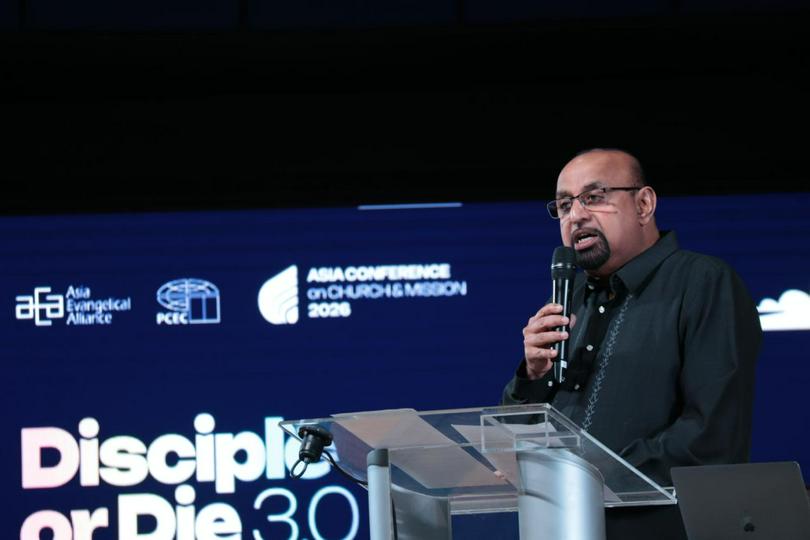
Godfrey Yogarajah has spent more than three decades in the company of churches under pressure. As the longtime CEO of the National Christian Evangelical Alliance of Sri Lanka—a minority Tamil Christian in a Buddhist-majority country—he has built legal aid programs for persecuted believers, navigated government ministries on their behalf, and trained church leaders across Asia and beyond on how to survive, and not merely survive but reproduce, under hostile conditions.
That history of working at the edge of institutional Christianity may explain why the theme of the Asia Conference on Church and Mission (ACCM) 2026 resonates with him so personally.
"If a church is not discipling, then it will die," Yogarajah said, sitting down for an interview on the conference sidelines. He is currently chairman of the Asia Evangelical Alliance (AEA) and chair of the newly constituted International Council of the World Evangelical Alliance—a body representing some 650 million evangelical Christians in over 160 countries.
The conference, held June 9–12 in Alabang, Metro Manila, gathered roughly 210 delegates from 25 nations under the theme "Disciple or Die 3.0."
The state of Asian Christianity, in Yogarajah's assessment, is genuinely hopeful—and that hopefulness is precisely what makes vigilance necessary. The global center of Christian growth has shifted toward the Global South, and many Asian churches are experiencing real momentum. But he pointed to what happened in the West as a cautionary template: churches that drew crowds without forming disciples eventually found themselves with empty buildings being converted into mosques, pubs, and apartments. "We have to be careful that as the church in Asia, we don't let it happen," he said.
What he sees in many congregations today is a quiet drift toward spectatorship—believers who attend services the way one attends a concert, seated and relaxed, watching rather than participating. For Yogarajah, this represents a structural failure, not just a pastoral one. A church, in his understanding, is a community of people who engage, who care for one another, who disciple and are in turn discipled. When that chain breaks, numerical growth becomes a misleading metric.
"The quantity and the quality have to both go together," he said. "If you want to sustain them, then discipleship is very key to the growth of the church and for the sustenance of the church."
This is the concern that gives ACCM 2026 its particular shape. The two previous "Disciple or Die" gatherings—this is the third iteration—served largely to introduce the concept and cast a vision. The third was designed, by contrast, to generate an action plan. Yogarajah described the AEA's goal as moving churches and leaders toward what he called the four C's: committing to the vision of disciple-making, connecting with one another, collaborating across networks, and cultivating frameworks that can be implemented at the local level.
One of the practical challenges he keeps returning to is the need to identify what he calls "champions"—people within local churches who believe in the vision enough to own it and push it forward. "It's not every pastor who wants to—he has too many things to be involved in," he acknowledged. "So we need to find champions within the church who believe in this vision, who own this vision, and who will make this vision a reality."
The question of whether Asian churches can sustain inner vitality is inseparable, in Yogarajah's view, from whether they can take genuine cultural root. Asian churches, he argued, need to hold the core doctrine of the gospel firmly while reexamining elements of church life inherited from Western cultural contexts—forms that the gospel itself does not require.
"We have to sometimes deculturize the gospel as well," he said.
He began with pews. In many South Asian churches, pews are standard—a Western import that replaced the traditional practice of sitting on the ground. Pulpits create a physical distance between preacher and congregation that feels unfamiliar when compared with how religious teachers and communities interact in neighboring Hindu, Buddhist, or Muslim contexts.
Then there is the question of shoes. In Buddhist temples, Hindu temples, and mosques across Asia, removing one's footwear before entering a sacred space is a fundamental gesture of reverence. When non-Christians visit a church and encounter people walking in with shoes on and sitting cross-legged, they can perceive a casualness that reads as disrespect—not because of any theological difference, but because of a cultural mismatch that was never necessary in the first place.
"Some Hindus and Buddhists who come to Christ," Yogarajah observed, "have told me that entering a church feels very strange—very different to their holy place."
This does not mean changing the gospel, he was careful to say. It means allowing the gospel to find expression in forms that are meaningful within Asian cultures—indigenous songs, indigenous instruments, and indigenous ways of gathering. He mentioned the tabla, the flute, and the diverse traditional instruments of China and Korea as resources that Asian churches have often underused in favor of Western worship styles adopted wholesale. "We need to be indigenous," he said.
China occupies a distinctive place in this broader Asian picture. Its size, the growth of its Christian communities over recent decades, and the global spread of the Chinese diaspora give the Chinese church an outsized significance in any account of Asian evangelicalism.
Yogarajah has visited China on multiple occasions, most recently in 2024, and described watching the relationship between the country's registered and unregistered churches change over time. Where there was once a strong division between the two, he now observes more interaction—including cases in which believers from unregistered churches obtain Bibles through registered channels.
"There seems to be more interaction, more unity within the church in China, which I see as a very positive development," he said.
The growth of Chinese Christianity has continued amid pressures and difficulties that outside observers tend to emphasize. From Yogarajah's perspective, the more notable fact is the resilience: "Still, they are a growing church, a very healthy church. I think the church from the West and the church from Asia can learn a lot from the Chinese churches."
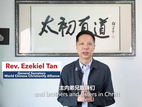
China is not yet part of the AEA's formal membership structure, a gap that Yogarajah hopes to see bridged in time. One development that encouraged him was the founding of the World Chinese Christianity Alliance (WCA). The WCA is the WEA's first alliance organized by ethnicity rather than by national borders, a recognition that the global Chinese church does not map neatly onto any single country.
Yogarajah attended the WCA's founding ceremony in Singapore and described being moved by what he witnessed: believers from registered and unregistered churches in China worshiping alongside Chinese Christians from other countries.
"All Chinese Christians coming together, worshiping together, and saying, let's work together because we want to follow Jesus Christ—that was very positive and very encouraging to us who were there as visitors," he said.
In his view, the WCA serves at least three interconnected purposes: giving Chinese Christians a stronger sense of belonging within the global body of Christ; creating space for partnership and collaboration with churches in other parts of the world; and enabling a flow of learning in both directions, since global Christianity has much to receive from the experience of the Chinese church, not only to give.
He also noted the WCA's planned commemorative events for 2027, which will mark the 220th anniversary of Robert Morrison's arrival in China—the moment in September 1807 when the first Protestant missionary to China set foot on Chinese soil, launching a ministry that would eventually produce the first Chinese-language Bible and the first Chinese Protestant church. For Yogarajah, that anniversary is not merely historical.
"I hope the AEA could take part in that celebration and encourage Chinese Christians there," he said, "so that they would also be encouraged and be part of Asia and the Asian Evangelical Alliance."
Running beneath all of this—the discipleship framework, the call to cultural rootedness, the push for Chinese Christian unity—is a conviction about what the church is fundamentally for. The church, Yogarajah said, is the only institution that exists for people who are not yet its members.
Every other club, association, or institution serves its existing constituency. The church, in his understanding, exists precisely to reach beyond it. "The church can't be inward-looking," he said. "The church has to be salt and light in the community."
That outward orientation is also reshaping where missionary energy comes from. Yogarajah said he had attended a meeting that afternoon focused on mission among overseas Filipino workers, where the emphasis was on equipping migrant Filipino Christians to serve as witnesses wherever their work takes them.
He mentioned Korean, Chinese, and Thai missionaries spreading the gospel across the globe—a formal sending from the Global South that would have been unimaginable a generation ago. A quieter form of mission is also underway in places like Israel, where Sri Lankan and Filipino workers in agriculture, elder care, and construction are carrying out witness alongside their jobs. Christian doctors, he added, are serving in restricted countries like the Maldives and Bhutan.
The pattern points to a shift in the geography of mission sending that is still unfolding. "We see this shift in the whole mission field and the mission-sending nations as well," he said. "And that's very encouraging."
For church leaders across Asia, Yogarajah's message returned to the two themes that structured the conversation. The first is unity: recognizing that all belong to one body, and that when one part of that body suffers, the rest is implicated.
The second is reproduction—not simply growth, but the kind of growth that generates more growth. "We need to be reproducing Christians where we help people to disciple, so they in turn will disciple others," he said, "people who will be rooted in the word of God, in prayer, and in working in the Holy Spirit rather than in the flesh." Mentoring, a discipleship framework, and working in unity, he said, are not optional additions to the work. They are the work.