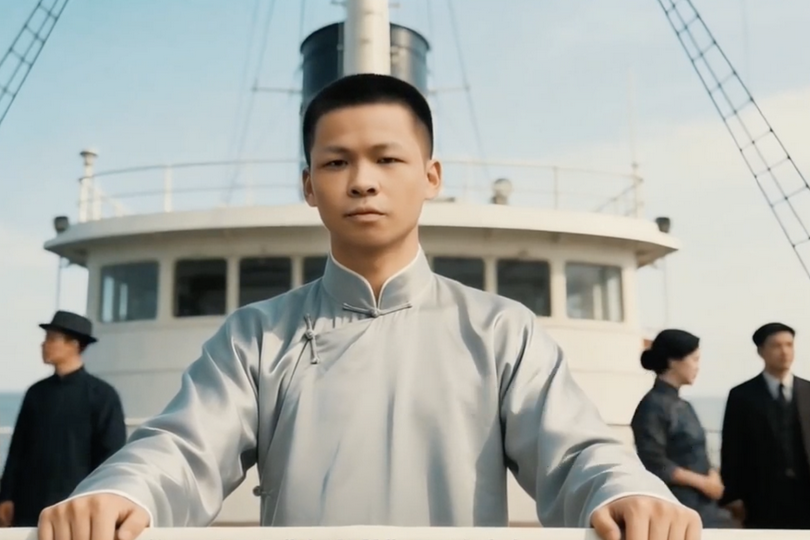
About two months ago, I watched "John Sung," an AI-produced biographical film about one of the most influential Chinese evangelists of the 20th century. Known as the "Wesley of China," Sung traveled extensively throughout China and made several evangelistic trips to Southeast Asia. Born in 1901, he died of illness in Beijing in 1944.
Adapted from The Sacrifice, a nonfiction biography by Chinese American Christian writer Shi Wei, the film traces Sung's journey from his studies in the United States and his crisis of faith to his return to China and decades of evangelistic ministry. It also offers glimpses into his family life with his wife and daughters. On October 31, the film received the Best IP Adaptation Award at the fourth International Chinese Original IP Film Festival.
Before watching the film, when reflecting on John Sung, I pictured a revivalist preacher who spent his life on the road and brought thousands to Christ. The film offered a more complex portrait of Sung, showing him not only as an influential evangelist but also as an ordinary man with personal struggles and weaknesses.
He grew weary, complained, and wavered between his ambitions and the calling. The film has its share of questionable choices, and it has drawn controversy, but it also left me a question to reflect upon: when AI is enlisted to retell the stories of figures from Christian history, what exactly does it bring to the table?
The "John Sung" on Screen: A Real yet Imperfect Man
There is a scene early in the film. One evening, Sung sits looking at a recommendation letter and a job offer on his desk, all but ready to say yes. Then the memory of his commitment to God surfaces again, the call to preach that has never really left him. Faced with a promising academic career, he still hesitates, even bargaining with himself for reasons to stay on the scholarly path. His inner struggle comes to a turning point when he recalls the words of Scripture, "For what shall it profit a man, if he shall gain the whole world, and lose his own soul?" He kneels and prays in tears.
To understand that struggle, we have to go back to his college years in the U.S. In 1920, Sung studied chemistry, first at Wesleyan University and then at Ohio State University. He was a brilliant student and an active one, a familiar presence in international student circles. He loved research and had every reason to expect a distinguished career, a professorship, the social standing that came with it, and a comfortable income with which he could put his younger brothers and sisters through school. Yet all the while, there was that calling he could not argue away. The film shows that his decision did not come easily. He wrestled with the tension between personal ambition, practical responsibilities, and his sense of calling.
From there, Sung went on to study theology at Union Theological Seminary in New York, and after returning to China, he gave the rest of his life to evangelism, preaching through exhaustion, urging repentance and new birth, and leading countless people to Christ.
Another scene that stayed with me comes from one of his preaching tasks. In late 1937, on the road to Fuyang, Anhui Province, Sung learns that his home has been burgled. His books and correspondence are gone. The news weighs on him, and with the journey itself treacherous and his past illness recurring, he comes close to turning back. It is late at night by the time he and his co-worker reach the town of Madian. They are cold and hungry, and check into a run-down local inn. The meal consists of noodles in chili oil, misery for a Fujian man like Sung. When he goes to bed, he finds crawling lice and leaps off in horror. Confronted with lodgings and food like these, he lets loose: "This place is like hell where bugs never die."
His co-worker, on the receiving end of this outburst, doesn't know what to do. After a while, Sung calms down, sits beside him, and sings: "In the cross, in the cross, be my glory ever…" The co-worker joins in, and the picture drifts toward the window. Their resolve renews, and they press on to Fuyang.
For me, this is one of the film's strengths. It refuses to mold Sung into a spiritual superhero who has no weaknesses or bad days. Instead, it lets us see the ordinary man underneath.
The Film's Strengths and Limitations
As a biographical film, "John Sung" is most effective when it connects key events in Sung's life with his inner spiritual journey, rather than simply listing his achievements in ministry.
The characterization is, on the whole, handled with restraint even in episodes that could easily have tipped into melodrama. Sung's 193 days in a psychiatric hospital, for instance, could have been easily filmed as a confrontation between Sung and the seminary, with Sung portrayed simply as a victim. The film avoids showing that confrontation. Instead, it seeks to portray the complexity of Sung's situation, while acknowledging the mental confusion he may have experienced under intense pressure.
The Fuyang journey mentioned earlier shows the same consideration with a character's emotions. According to written accounts, the real Sung reacted far more violently than the film allows. After that terrible bowl of noodles, he is said to have hurled the bowl to the floor. The film softens the moment considerably: he takes one bite, winces, and pushes the bowl away.
Then there is the film's audiovisual side, which is more open to debate. As an AI production, it carries some conspicuous technical mistakes. In a few shots, the subtitle is scrambled; in the preaching scenes, the congregation members look suspiciously alike and react in eerie unison, leaving a distinctly mass-generated impression. These flaws are a useful reminder that while AI can generate images at remarkable speed, the results do not always match the visual consistency and coherence of traditionally produced films.. And yet, I have to confess that the film's AI-composed music genuinely moved me. Which, in turn, I find it rather hard to accept. I was initially reluctant to admit that AI-generated music could move me so deeply.
Overall speaking, the film's technical errors are real and visible, but so is its genuine attempt, through a new way of making films, to bring an important man from Chinese church history back into view for audiences today.
AI Puts Historical Figures on Screen
To my mind, AI opens up genuinely new possibilities for retelling the lives of Christian historical figures. A historical biopic used to demand serious money, large crews, extensive location work, and a long and complicated production. Now, with AI, stories that were once shelved for lack of funding and production capacity have a real chance to be projected on screen.
Chinese church history is full of figures whose stories deserve to be recorded and told, for example, Wang Mingdao and Watchman Nee, to name just two. Their lives, their faith, and the church history of their era all merit closer study. Yet for all sorts of practical reasons, few of these stories have ever been given a film adaptation. AI may well change that.
Who Is Responsible for the Truth?
New creative territory brings new problems, though AI can generate images that look utterly convincing but are not necessarily historically accurate.
A film can render a building that looks every inch an early-20th-century American seminary; it can populate it with students in costumes; it can produce a John Sung who looks uncannily like the man in the historical photographs. However, whether those images match the real architecture, the real faces, the real texture of the era, still has to be worked out by the filmmakers. What makes it more insidious is the illusion such realism creates in the audiences: if it looks this real, surely it happened this way.
Facts may be different. Anyone telling the story of a historical figure has to keep three things apart: what the sources actually document, what is reasonably reconstructed for storytelling purposes in service of the story, and what is outright artistic invention. For instance, the prayers Sung utters at the crossroads of his academic career and his various inner monologues should be clearly understood as the filmmakers' creation, not as the man's own words unless they are evidence-based.
For Christian filmmakers today, this film offers worthy reflections. AI may make it possible to bring more figures from Chinese church history to the screen. But whatever advances the technology brings, the fundamental responsibilities remain unchanged: to portray history accurately, treat the people involved with respect, and take their faith seriously.
- Translated by Charlie Li
Originally from the Evangelical Vision
CCD edited and translated with permission