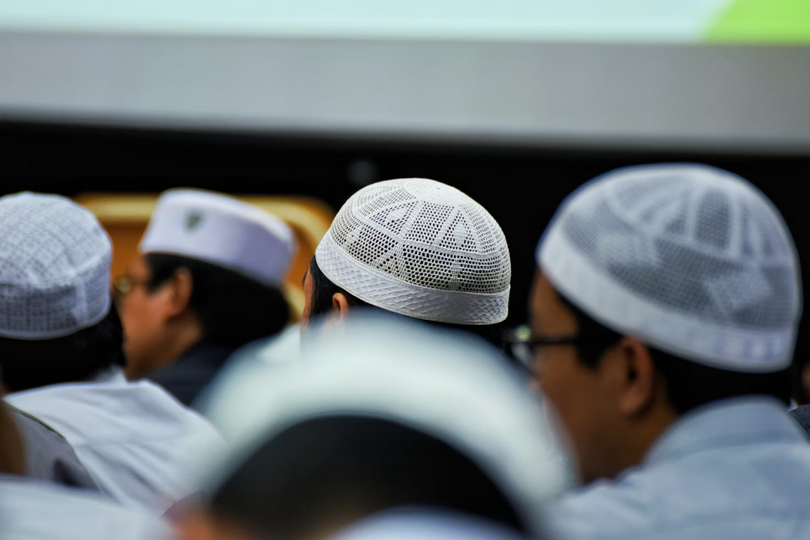
In Brother Barnabas's childhood memories, wearing a white cap was the hallmark of religious piety.
To judge whether a Hui Muslim was genuinely faithful, the first thing people looked at was their attire. For men, it was the white skullcap; for women, the head veil. Especially in public, wearing the cap or veil was a silent declaration: "I am Hui, and I observe Islam." If someone was seen without it, the elders would instantly cast doubt on the sincerity of that person's belief.
To be even more specific, if someone laid down their work on Fridays to go to the mosque solely for worship, that person was considered a truly devout believer in the community. In local custom, this was the ultimate verification of one's faith. As a child, Barnabas used to admire those who were able to attend Friday prayers. Avoiding pork, observing Ramadan, and paying respects at ancestral graves—these observances were all seen as proof of devout belief.
Then there were the daily prayers—five times a day: dawn, noon, mid-afternoon, sunset, and night. Whether on a train, on the road, or at home, when the time came, one would lay out a prayer mat, face west, and bow. In places where religious rules were strict, every ritual had to be practiced without fail.
In addition, the greatest honor of a lifetime was to make the pilgrimage to Mecca. If a family member went, it was a monumental event. Relatives and friends would gather to host a farewell party, and upon their return, there would be grand welcomes with celebratory banquets. In everyone's mind, this meant that one had reached the pinnacle of faith and that a lifetime's worth of merit was complete.
However, in the inland regions that had been deeply assimilated, it was hard to fulfill all these observances. If a man wore a white cap and a woman a light scarf, that was often considered devout enough. "We believe in Allah alone," the imam would say—words Barnabas heard all his life. Yet, regarding who Allah truly is, he felt a disconnect. To the young Barnabas, it seemed that no one in his clan had truly read the Qur'an. Faith had become little more than an ethnic identity.
So, in Barnabas's childhood, the measure of devotion lay entirely in rituals. As for what kind of relationship one actually had with Allah in one's heart or whether one truly knew him, no one cared, and no one taught about it. Faith seemed to consist of nothing more than a white cap, repeated bows, and a long and highly regarded pilgrimage.
When his first marriage broke down, he left everything he had toiled for to his ex-wife and walked away with nothing. Like a man clutching at a lifeline, Barnabas rushed to the mosque. He thought he would find wisdom and comfort there, but the white-bearded elder sitting at the entrance merely offered platitudes that completely missed his pain. In that moment, something inside him collapsed.
Since that day, the inner door that connected him to his ethnic religion gently shut. He remembered learning qigong as a child. His coach always appeared calm and composed. The coach was a Buddhist who not only taught martial arts but also taught people to be good. Influenced by this, Barnabas began turning his attention toward Buddhism, hoping to find inner release and peace there.
Barnabas ended his first marriage, raising a five-year-old daughter, and his life was drifting into fog when he met Azhen, who had come to work at his sister's clothing shop and would later become his wife.
Azhen was nineteen, quiet and hardworking, with a quality unlike any woman he had known before, a gentleness and steadiness from within. She was also a committed Christian. At that time, however, her spiritual life was at a low point. She had left her hometown to work elsewhere and had been away from church for two years.
When Barnabas raised the possibility of marriage to her, Azhen unexpectedly agreed.
So, they married, and for a while their married life was calm until a disaster struck Azhen.
Azhen became pregnant. Overwhelmed by financial pressure and fear of their unstable circumstances, they made the heartbreaking decision not to keep the child. In their desperation and lack of spiritual depth at the time, they opted for what seemed like a "quick fix"—abortion pills.
However, the aftermath was harrowing. After taking the medication, Azhen lay in bed in agonizing pain for two full days, suffering intensely.
Barnabas was urged to call his mother-in-law to come. As Azhen lay there nearly unconscious from pain, her mother stood by the bed and said to her, "My child, we believe in God. You need to pray, pray earnestly to the Lord, whether He allows this!"
Barnabas was urged to call his mother-in-law. Seeing Azhen nearly unconscious from the pain, her mother stood by the bed and said firmly, "My child, we believe in God. You need to pray. Pray earnestly to the Lord, and see if He will have mercy!"
Azhen began to pray in a weak, broken voice: "Lord, save me… Lord, save me…" Gradually, her murmurs turned into sobbing, which slowly subsided. Her mother urged her again, "Azhen, ask the Lord to let you sleep for a while." She hadn't slept for two days due to the pain.
Then, a miracle happened. In an instant, the excruciating pain vanished. In less than two minutes, Azhen fell into a deep sleep.
Guided by his mother-in-law, Barnabas made a prayer of commitment to the Lord Jesus. Afterward, he broke down in loud sobs as he finally felt relieved and got a sense of belonging. From that moment on, he stepped onto this path of faith, nearly thirty years now without ceasing.
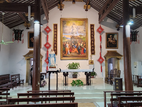
The road of conversion was not smooth. At family gatherings, relatives would give him looks of mixed disapproval when they saw he no longer wore the white cap. Yet, he knew clearly that what he had found was no longer a god confined to religious rules but a living God. In Christian fellowship, he experienced for the first time what "growth in life" meant. They read Scripture, prayed, and supported one another. Faith was no longer a once-a-week Friday ritual at a mosque but a daily, intimate walk with God.
He also tried to share the gospel with his family, but soon realized how deeply entrenched things were. In the end, he reached a delicate balance with them: they no longer urged him to return to the clan's religion, and he no longer pressed them to believe in Christ. "Maybe it's because I'm older," he said with a wry smile. "If young people were to convert, they'd probably be completely cut off from the family."
He recalled a pastor who once traveled to a distant region to preach the gospel. Years later, although the pastor had sown seeds, he was unable to establish a visible church. The local soil was so hardened that a public baptism could stir up the community to severely persecute the new believer.
Today, Barnabas still accompanies his family clan during Ramadan, visiting his relatives and honoring ancestors with the clan. However, in his heart, he carries a different kind of peace. He understands his people's devotion to tradition, and he also understands the emptiness behind that devotion when faith is reduced to wearing white caps, avoiding pork, and Friday prayers—that the human heart remains unsatisfied and hungry.
He often recalls the miracle of how his wife's pain suddenly stopped. "Faith shouldn't be a label to prove how different you are," he says. "It should be the help you can get when you cry out in pain, the guidance you can find when you are lost, and the healing you can receive when you are broken."
(The names of the characters in the article are not disclosed for safety reasons.)
- Translated by Charlie Li