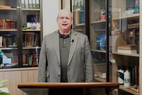
Professor Peter Kreeft is one of the most distinctive contemporary Catholic philosophers and writers, known for bringing the classical Christian tradition into conversation with questions of faith, reason, doubt, suffering, and the search for meaning.
In this interview, Kreeft reflects on the deeper roots of human loneliness, the relationship between faith and reason, the spiritual significance of simplicity and silence, doubt, death, Divine love, and our moral responsibility toward animals. The conversation also explores spiritual experience and religious truth claims, as well as Persian mystical thought and the relationship between Islam and Christianity.
The conversation moves between Kreeft's distinctly Christian understanding of God and questions that remain open across religious and philosophical traditions: whether spiritual experience can be trusted as evidence of God's presence, whether fear has a place in our relationship with the Divine, where moral responsibility toward animals begins and ends, and whether truth can be separated from the religious traditions that claim to embody it.
Shiva Akhavan Rad: In your writings, you frequently speak about a deep existential loneliness in modern humanity.
From your perspective, what is the root of this loneliness? Can we say that by turning away from God—and forgetting the Divine love—we lose part of our true self?
Peter Kreeft: The problem includes, but is broader than, loneliness. If we are designed and created by God for union with Him, if the most famous Christian sentence outside the Bible is true (Augustine's "Thou hast made us for Thyself, and (therefore) our hearts are restless until they rest in Thee"), it is the absence of God in our lives, our souls, and our consciousness that is the problem. It is a perennial, not a merely modern, problem.
Like anger, boredom, addiction, uncertainty, and shallowness, it is one of many symptoms of a disease that is well known. If God is the source of all good and all joy, our disease is well known, and the advice of our forefathers in the faith is correct today. Nothing else can fill the infinite hole in our hearts except the infinite God. Even if all human loneliness on the natural, or horizontal, level were taken care of, we would still be lonely. One of the reasons marriage is in crisis is that in the absence of God we often seek total satisfaction—the filling of this infinite hole in our hearts—from another human being, and that is to put divine expectations on human shoulders and is sure to disappoint. Idolatry (treating as God, as #1, as the Greatest Good, anything other than God) is the foundational sin; that is why it is the First Commandment that negates it. And the more like God the idol is, the more it lures and promises. Every religion (as distinct from God Himself) can be an idol; so can family, marriage, romance, friendship, pets, work, food, drink, or smartphones (in descending order).
Shiva Akhavan Rad: You often describe faith, reason, and intuition as three pillars of spiritual understanding. How do you personally cultivate intuition, and what practices would you recommend to your readers?
Peter Kreeft: "Reason" used to mean both calculation (logic) and intuition (immediate understanding). Reason (our own thinking) and faith (in others and theirs, especially God's) are our two ways to truth. Within reason, intuition has atrophied and calculation has flourished because we have become like our servants vs. computers. We need to exercise the intuitive part of our brain too: creativity, imagination, analogies, poetry, imagery, allegory, story, and music—not just for enjoyment but also for intelligence. Reading great novels and plays is a more effective education in psychology and sociology than those sciences are.
Shiva Akhavan Rad: You often say that many spiritual questions become clearer through a "return to simplicity." What does this simplicity mean to you, and what do you see as the first and most essential step toward returning to it?
Peter Kreeft: What simplicity is, is simple! You see it in children—even in babies. Look at the look on the face of a baby, cradled in the arms of its mother, as it looks up at her smiling face: there you see, rather than figure out, how faith, hope, and love can be one reality. In the same way, the mind and the will, or the heart, are ultimately one power and one reality. Three divine Persons are yet all one thing, not a collection.
The way to recover this is through trust: that attitude on the baby's face. We can't just omit, forget, deny, or ignore the complexifications and distinctions that our growth into adulthood has given us, but we can use them to recover this simplicity.
For example, we can use our definitions of God's omnipotence, omniscience, and omnibenevolence by adding them together as premises that conclusively prove the conclusion that justifies our total trust in Him, viz. Romans 8:28. Of course, we forget this, even if we do sincerely believe it, so we have to keep reminding ourselves. Muslims call this "ghaflah," a kind of Original Sin of forgetfulness; that is why they pray five times a day.
Shiva Akhavan Rad: Many young people today live with a kind of existential skepticism. Do you see doubt as the enemy of faith—or as an integral part of the journey toward it?
Peter Kreeft: Doubt, when personal, is at war with faith and trust, but God allows these trials and temptations to exercise and strengthen our faith. He did that even with His own Son in exposing him to real temptations by the Devil.
Honest doubts—"Is it really true or not? I want to know the truth above all things; truth is an absolute"—this is a good thing. It is the slap on the side of the horse to make him move. But only if its end is truth, because truth, like love and joy, is one of the things that God is.
Shiva Akhavan Rad: In Three Philosophies of Life, you present three lenses for understanding existence: Tragedy, Comedy, and Romance. Which of these do you believe best describes the future of humanity?
Peter Kreeft: Life is all three; that is why we find all three kinds of story realistic. They even interpenetrate, for the Greatest Story Ever Told, the life and death and resurrection of Christ, which is a tragedy that is really the greatest comedy (the great joke on the Devil) to fulfill God's desire for a romance and marriage to us toads that His kiss in Christ turns into princes and princesses.
Shiva Akhavan Rad: You have written that "truth is both beautiful and terrifying." For you personally, what is the most beautiful truth—and what is the most frightening one?
Peter Kreeft: The most beautiful truth and the most frightening truth are the same: God. That is why, when we die, we will be given a glimpse of the Beatific Vision of God's beauty so that throughout our ensuing Purgatory the pain of the absence of that vision will be our greatest pain, and the pain of shame for our sins against that Beauty and Goodness will be our second greatest pain. (This profound idea is not mine but that of the saints: Catherine of Genoa and Alphonsus Liguori.)
We are shallow and external creatures, so we fear physical pain the most, but these spiritual pains are far deeper. Yet in Purgatory they are also willed, healing, and hopeful, and even joyful, like the pains of childbirth.
Shiva Akhavan Rad: Contrary to common belief, I see death as a profound release: a liberation from the physical body, a resting in God's embrace, and a continuation of the soul's journey. I would like to ask: does your own view of death also contain this sense of peace, release, and ongoing spiritual progress?
Peter Kreeft: Of course, death is a good release from sin and pain but not a good release from both. God gave us bodies at creation and will again at the resurrection. Even these bodies, instruments of sin, are good. Death is not in itself a good but an evil, "the last enemy." But God makes the greatest evils serve the greater goods, as He did on Calvary.
Shiva Akhavan Rad: Persian mystical literature is rich in themes such as Divine love, the freedom of the soul, and annihilation in God. Have you encountered these traditions and ideas in the course of your intellectual and spiritual development?
Peter Kreeft: All the great sages have discovered these things. God often works anonymously.
Shiva Akhavan Rad: In today's noisy world, silence has become rare. Why do you believe silence is so essential for spiritual growth?
Peter Kreeft: We want to be surrounded by our own noise so that we cannot hear the voice, word, revelation, speech, or whisper of God. This is why the poor, especially the voluntarily poor, the "poor in spirit," are blessed; their lives, though painful, are simple.
Shiva Akhavan Rad: In your philosophical and spiritual development, what moment or experience has most profoundly shaped your understanding of spirituality?
Peter Kreeft: I have had no spectacular or sudden experiences. And if I did, I would not tell you, for fear you would envy them and seek them. We do not seek experiences; we seek God. Nor do I like the word "spirituality." The Devil is very "spiritual but not religious."
Shiva Akhavan Rad: Animals are sacred creations of God, and through their existence they glorify Him. Given that humans have power over the earth but often use that power to cause suffering to animals, do you think this perspective could lead to a deeper ethical reconsideration of killing and consuming animals? Even though animals, like us, can feel pain and experience suffering, their treatment is often very different from our treatment of pets. Could Christian compassion call us to reconsider how we treat animals more broadly? And does this concern relate to your statement that God is kind but also gets angry?
Peter Kreeft: As I respect the motives of pacifists, I respect the motives of vegetarians. But a line must be drawn somewhere between what is permissible and what is not. Ancient Israel's line was between kosher and non-kosher meats and fish. Most of us eat chickens but would not eat a pet bird; venison but not a pet deer. Let everyone follow their own conscience here. What we do, though important, is not as important as why we do it and for whom (or for whom).
I sympathize with that sentiment, and I think it is harmful to humans spiritually to cause needless pain to animals and certainly to torture them, but God Himself legislated eating certain animals in the Jewish scriptures, and Christians have almost always followed that. I would never eat an animal that was or could be a pet, but I think no one would balk at eating locusts or ants, so I do not have a clear notion of where to draw the line.
The issue, to me, is like pacifism: my head and my heart are not in perfect tune. I sympathize with pacifists but cannot honestly embrace it as a requirement for all, though I respect it as an option for some. Just out of curiosity: Were your parents Hindu? Why were you named after the god of destruction?
Shiva Akhavan Rad: My parents are Iranian, and they simply loved the name "Shiva." In Persian and broader philosophical interpretations, Shiva is not understood purely as a god of destruction in a negative sense, but rather as a force of clearing, transformation, and renewal—the dissolution of old energies to allow a new cycle to begin. In Persian, "Shiva" also means "eloquent," "articulate," or "expressive." When you hear the name "Shiva," do you primarily think of destruction or of transformation and renewal?
Peter Kreeft: Both, as most Hindus do. Joy, gratitude, and the love of life are usually associated with Vishnu, while fear, death, and the destruction of evil are associated with Shiva. We need both. "The fear of the Lord is the beginning of wisdom," but love is the end.
Shiva Akhavan Rad: I was born Muslim, but I do not identify with any organized religion. Regarding your point on the fear of God, I must respectfully disagree. In my view, fear is not an inherent aspect of God's nature. Instead, God is the source of pure love, affection, and compassion. The notion that we must fear God has, in my opinion, been a misinterpretation throughout history. Fear does not align with the true essence of God, which is love.
Peter Kreeft: What you identify with sounds like religion to me: a personal relationship with God. Do you pray? If so, that is religion. Of course there is no fear in God, nor should there be fear in us of God as if He were an enemy or evil for us. But "fear" also means "awe, wonder, respect, and humility before greatness and goodness," and that fear is "the beginning of wisdom."
But visible religions also make truth claims. Either the Koran is infallible or not. Either Jesus is who He claimed to be or not.
Shiva Akhavan Rad: You mentioned that, when it comes to questions of religious truth and visible religious traditions, you tend to focus more on an internal experience of the Divine. Could you tell us more about what that experience means to you? Do you see it primarily as a personal or subjective experience or as something that points to an objective reality of God?
Peter Kreeft: "Experiences" are not merely your own feelings, but rather the objectively real presence of God. God is present to you and loves you just as much when you do not have those feelings as when you do. I learn much by comparing religious experiences with others, and I do believe that God is far more "ecumenical" than we usually think.