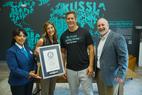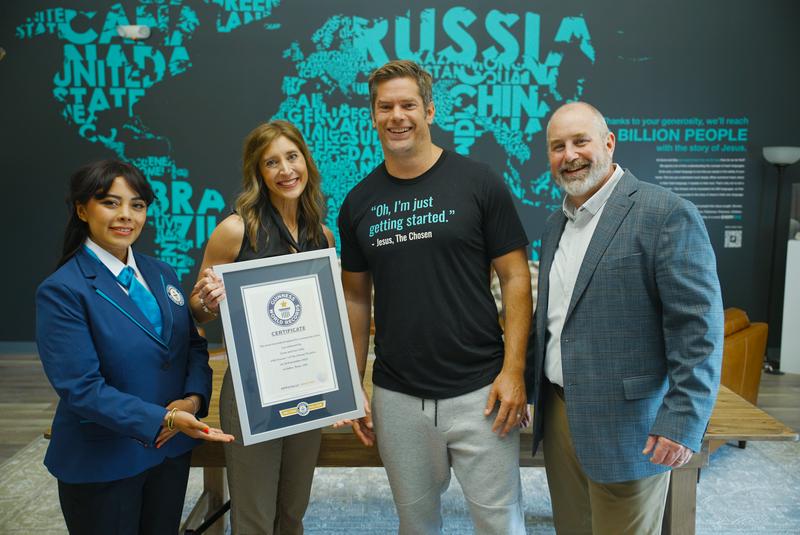

As the American biblical TV drama The Chosen continues its global expansion, Dr. Wendi Lord, vice president of localization for the Come and See Foundation, has led the translation team to break the Guinness World Record for the most-translated series in history by achieving 86 language translations.
For millions of viewers around the world, it serves as a new way to encounter the story of Jesus in their own language. In an exclusive interview with China Christian Daily, Lord shared how translators, theologians, pastors, and emerging technologies are working together to bring The Chosen to audiences in their "heart languages."
Reaching Viewers Through Their Heart Language
Since its launch, The Chosen, a widely popular, crowd-funded historical drama television series about the life and ministry of Jesus, has been translated into 125 languages, allowing nearly 300 million people to watch the series in what Lord calls their "heart language"—the language that speaks most deeply to their identity, family, and culture. Now, five reasons have been available, with Season 6 in post-production and Season 7 to be shot.
According to Lord, one reason The Chosen has resonated so deeply with audiences worldwide is its ability to make biblical characters feel real and relatable.
"The writers of the show are so gifted," she said. "People often tell us, 'That episode felt like it was written just for me.' They see themselves in characters like Matthew or Mary and connect with their stories."
Language has also played a critical role in the show's global impact.
"When we can hear the story of Jesus in our own heart language, it unlocks something in our heart," she explained. "That's where real transformation can take place."
Lord noted that many younger viewers may understand English or other major languages, but older family members often remain most comfortable in their native tongue. Translation enables entire families to experience the series together.
More Than Translation
While viewers may simply select a language option on the app, Lord emphasized that each translation involves a complex process.
For 75 major languages such as Mandarin Chinese, Arabic, Hindi, French, and Italian, professional translators first create a draft translation. "They are focused on lip sync and movement to get the dubbing right."
What distinguishes The Chosen from many other productions, however, is the extensive theological review that follows. "We pair translators with theologians to ensure the translation stays faithful to the Bible," Lord said.
After the script is translated, voice actors record the dialogue. The recordings are then reviewed again by language experts to ensure accuracy and consistency.
For each language, teams typically include translators, theologians, pastors, linguists, dubbing directors, recording engineers, and dozens of voice actors. But for lower-resourced languages, there will be an initial AI draft overseen by a theologian and a linguist.
"That makes it sound simple," Lord said. "But those steps require a lot of effort to make each one happen."
Usually, there is a small team of two to six people for one language, including translators, theologians, and language experts. But the cast has more than 100 actors and about a dozen people working behind the scenes.
Chinese audiences currently have access to three language options, including Mandarin, Cantonese, and Traditional Chinese. Lord explained that language selection is guided by extensive research, including population statistics, existing Bible translations, and technological accessibility.
The Challenge of Translating
Translation is not merely a linguistic exercise. For a series rooted in Scripture, words carry theological significance. Lord described numerous challenges that emerge when biblical concepts are translated into different cultural and linguistic contexts.
For example, references to the Holy Spirit can vary considerably across languages. Some cultures use feminine forms, others masculine, while still others employ gender-neutral language.
Questions also arise regarding how characters should address Jesus.
"In some languages, there is a formal and informal way of saying 'you,'" she explained. "Some people will refer to him in the formal you, others in the informal, depending on the character in the show and their familiarity and relationship with Jesus."
At times, translators and theologians spend significant time discussing the intent behind a particular line or scene before determining the most appropriate wording.
"We dig into the Bible, we talk about the scene, and then we work to find the right words for that culture and context," she said.
But Also Inspiring Stories
Among the translation process, there are also meaningful stories.
A professional translator working on The Chosen was not initially a follower of Jesus. However, after spending months immersed in the scripts and translating the life of Christ, the individual reached a life-changing decision.
"After working on The Chosen, the translator told us, 'I've decided to give my life to following Jesus because the show seeped into my heart as I was working on the translation," Lord recalled.
Another encouraging report recently came from Asia, where supporters celebrated the completion of Season One in a local language. They noted that translating the Bible into their dialect had once taken more than a century, while another translation required 25 years. By comparison, the completion of an entire television season in a relatively short period demonstrated how technology and global collaboration are accelerating access to Christian content.
After watching the show, a Chinese Christian told Lord that The Chosen was a reminder of why they have the Christian faith: "My belief in God gives me peace and joy in the midst of difficult times."
How AI Is Helping Expand the Mission
As translation efforts continue to grow, artificial intelligence has become an increasingly valuable tool.
For lower-resourced languages—where professional studios, dubbing infrastructure, or large translation teams may not exist—AI provides an initial draft that can then be refined by human experts.
She believes AI will reshape translation work, though not replace human translators.
"I believe AI will do to translation what the microwave did to the stove," she said. "We still have a use for both."
"Sometimes we just need something very fast, and we use the microwave, but we still have many cases when we want something to simmer and go quite slow."
AI is also creating unexpected opportunities. In some regions where Christians face security concerns, "we can cover their voices to make sure that they cannot be identified, and we can keep them safe."
Looking Toward 600 Languages
Translation is one of the core pillars of Come and See Foundation's global mission, known internally as "Speak to the Heart."
The organization's goal is ambitious: to make at least the first season of The Chosen available in 600 languages by 2033, marking the 2,000th anniversary of Christ's earthly ministry.
Lord acknowledges that the challenge is enormous but believes it is achievable through the collective efforts of translators, theologians, churches, and supporters around the world. "We hope to launch Season 6 in 60 languages worldwide, and so look for Season 6 this fall."
"There is still plenty of work to do," she said. "Millions of people have not yet heard this story."
For Christian translators, media workers, and storytellers, her encouragement is straightforward.
"Continue creating excellent content," she said. "Continue sharing it with the world. People still need to hear about Jesus." For the younger generation, high-quality video content can make the Bible alive, especially in an era when video content platforms are competing for their attention.
For Chinese Christians, Lord mentioned that as 2026 is the year of the horse, which represents freedom, independence, and a powerful call to decisive action, she urged them to take action. "Let's take decisive action and start telling people about Jesus, about The Chosen, and share his love."
"I would want to say that God bless you, keep you, and make His face to shine upon you, and keep you in perfect peace," she concluded.