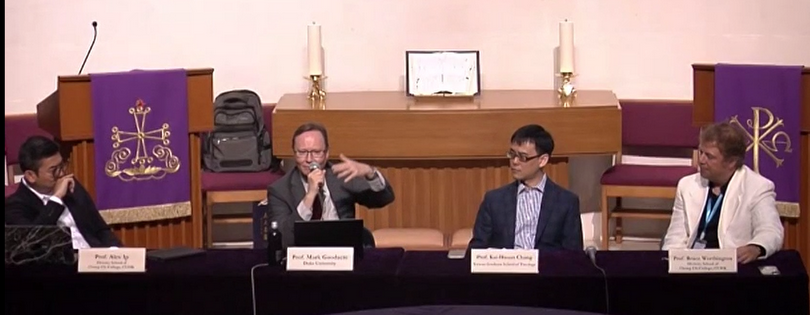
On March 28, Professor Mark Goodacre of Duke University argued that the Gospel of John was written with direct knowledge of Matthew, Mark, and Luke, challenging a long-standing scholarly consensus of its independence in a two-part lecture titled "Was John the Fourth Synoptic Gospel?" at the Divinity School of Chung Chi College (DSCCC), The Chinese University of Hong Kong.
The event, as the 28th Chuen King Biblical Lectureship, was chaired by Prof. Hon-Ho Ip of DSCCC. Following Prof. Goodacre's lectures, responses were provided by Prof. Kai-Hsuan Chang, an assistant professor at Taiwan Graduate School of Theology, and Prof. Bruce Worthington, an assistant professor at the host divinity school.
In his first lecture, Prof. Goodacre outlined his argument against the dominant 20th-century view, popularized by scholars like Prof. C. H. Dodd, which holds that John developed independently from the Synoptics. Prof. Goodacre described this prevailing view as a "Johannine firewall" that has obscured the deep connections between the four canonical Gospels. He then presented five categories of evidence for John's direct literary dependence.
He began by highlighting significant verbal agreements. In the healing of the paralytic, both Mark and John use the same distinctive Greek word for "pallet" (krabbatos). In the walking on the sea narrative, Jesus's declaration "I am, do not fear" (ego eimi, mē phobeisthe) appears with near-identical phrasing in both Mark 6:50 and John 6:20.
Prof. Goodacre then argued that John appears to know not just Mark, but also Matthew and Luke's modifications of Mark. In the burial narrative, Mark describes a tomb "hewn out of the rock" (15:46). Matthew adds that it was a "new" tomb (27:60), and Luke further specifies it was one "in which no one had ever been laid"(23:53). John's account (19:41) combines both additions.
He also pointed to shared passage structures, citing the anointing of Jesus at Bethany. The story in John 12 follows the same seven-point narrative sequence as in Mark 14, including the specific detail that the perfume was worth "300 denarii"—a phrase that Prof. Goodacre noted makes its first appearance in Greek literature in Mark, and its second in John.
Finally, Prof. Goodacre addressed overall gospel structures and conceptual frameworks. He noted that the Triumphal Entry occurs at a nearly identical proportional point in both Mark and John, suggesting both can be seen as "a passion narrative with an extended introduction." He also argued that John shares the Synoptic concept of a "hidden Messiah," employing a similar literary conceit of "insiders" who understand and "outsiders" who do not, with the resurrection serving as the ultimate "hermeneutical key" in both traditions.
In his second lecture, Prof. Goodacre explained how John used this shared Synoptic foundation to perform a "Christological transformation." He stated that while the Synoptic Jesus primarily proclaims the kingdom of God, John's Jesus proclaims himself. However, Prof. Goodacre stressed that the core purpose remains the same, citing John 20:31, which states the book was written so that readers "may believe that Jesus is the Messiah, the Son of God"—a central Synoptic designation.
He demonstrated that nearly every Christological title used in the Synoptics—including Messiah, Son of God, Son of Man, Lord, and Prophet—also appears in John. Even John's most distinctive feature, the "I Am" sayings, has its origins in Synoptic imagery, Prof. Goodacre argued. For example, "I am the good shepherd" (John 10) builds on parabolic imagery of the lost sheep in Matthew 18:12–14 and Luke 15:3–7, and "I am the light of the world" (John 8 & 9) adapts a phrase Jesus uses for his followers in Matthew's Sermon on the Mount (5:14).
The high Christology of John, with its emphasis on the Father-Son relationship, may also have its "seed" in the Synoptics, Prof. Goodacre suggested. He pointed to a passage in Matthew 11:27, often called the "Johannine Thunderbolt," where Jesus states, "No one knows the Son except the Father, and no one knows the Father except the Son." This saying, though sounding uniquely Johannine, is present in the Synoptic tradition and provides a theological basis for John's later development.
Prof. Goodacre concluded that seeing John as the Fourth Synoptic Gospel clarifies its purpose as a work intended not to replace the earlier gospels, but to supplement and interpret them.
Following the lectures, two scholars offered their responses.
Prof. John Kai-Hsuan Chang, a New Testament scholar from the Taiwan Graduate School of Theology, affirmed Prof. Goodacre's model of interaction. He suggested that John's Gospel could be seen as a "higher and more concrete version of the Transfiguration event," where the glory revealed privately on the mountain is made public throughout John's narrative. Prof. Chang raised questions about the historical context that would generate such a gospel, questioning whether the traditional view of an isolated "Johannine community" still holds if John was in active dialogue with the Synoptics. He also asked Prof. Goodacre to elaborate on the role of the term "Logos" and the potential influence of Pauline theology on John.
Prof. Bruce Worthington, a CUHK professor specializing in early Christianity and critical theory, framed Prof. Goodacre's work through the lens of intertextuality, referencing theorists like Jacques Derrida and Roland Barthes. He praised Prof. Goodacre's critique of scholarly appeals to untraceable "oral tradition," aligning it with Derrida's principle that "there is nothing outside of the text." Prof. Worthington described the gospels as a "multidimensional space in which a variety of writings, none of them original, blend and clash." He concluded that viewing John as an intertext that engages with the Synoptics is, paradoxically, a return to more ancient, traditional ways of understanding the gospel, such as the view held by Clement of Alexandria.