

At 6:30 a.m. on October 7, 2023, explosions jolted Ola Metzger awake. Living just seven kilometers from the Gaza border in Kibbutz Nir Oz, she was no stranger to rocket fire. But this morning felt different.
As sirens and blasts echoed, Ola rushed with her husband and children into the family's mamad—a reinforced safe room with steel doors and fire-resistant walls. Within minutes, messages flooded a community mothers' WhatsApp group. A neighbor, Mary (pseudonym), warned that beyond rockets, armed militants were moving from house to house, setting fires and abducting residents.
"Please stay hidden," Mary wrote. "Are you all okay? We're okay for now. If anyone needs help, tell me."
For the next several hours, the group filled with frantic updates—voice notes, videos, and pleas for help. By the time Israeli Defense Forces reached Nir Oz, nearly six hours had passed.
Founded in 1955 in Israel's western Negev, Nir Oz was home to about 400 residents and more than 200 houses. On October 7, it became the hardest-hit rural community in the country. According to residents, at least 41 people were killed that day; the overall death toll later rose to 47. Seventy-six residents were kidnapped and taken to Gaza. Of those, 53 have since returned alive.
Ola, whose parents-in-law, Yoram and Tamar Metzger, were abducted from their home, shared her family's experience during a visit to the kibbutz as part of the Seven Christian Media Summit in early November. The summit was hosted by Israel's Government Press Office (GPO) in collaboration with the Ministry of Foreign Affairs and the International Fellowship of Christians and Jews (IFCJ), bringing together more than 150 Christian journalists and communicators from over 40 countries.
During the attack, Nir Oz's only defense came from roughly a dozen young adults who formed an emergency response team. They faced more than 500 Hamas fighters, along with some civilians from the Gaza Strip who crossed the border during the chaos.
John (pseudonym), a member of the response team, secured his wife and four-month-old daughter in his home before taking up arms. He was killed shortly afterward, his body later found near a gazebo behind a kindergarten. His wife and the four-month-old baby, and other children who played there, went out from the window of their safe room and eventually survived until the army arrived. When Ola next saw his wife and baby, the infant was completely unclothed. Fires had been set to force people out of their safe rooms, and the heat was so intense that the mother had stripped her child to help her survive.
Arson was one of the attackers' most common tactics. According to messages circulating among residents during the siege, militants often moved in pairs or small groups—setting homes ablaze, firing at doors, and attempting to force people out of safe rooms. The extent of destruction varied widely.
"It is like a Russian roulette," Ola said. "It depends on who came into your house and how much effort they made in order to get you out of there."
Her own family survived. The attackers entered and exited her house four times but eventually left without breaching the safe room. She later reflected that keeping the small reinforced room during a home renovation—a choice she had once questioned—saved their lives.
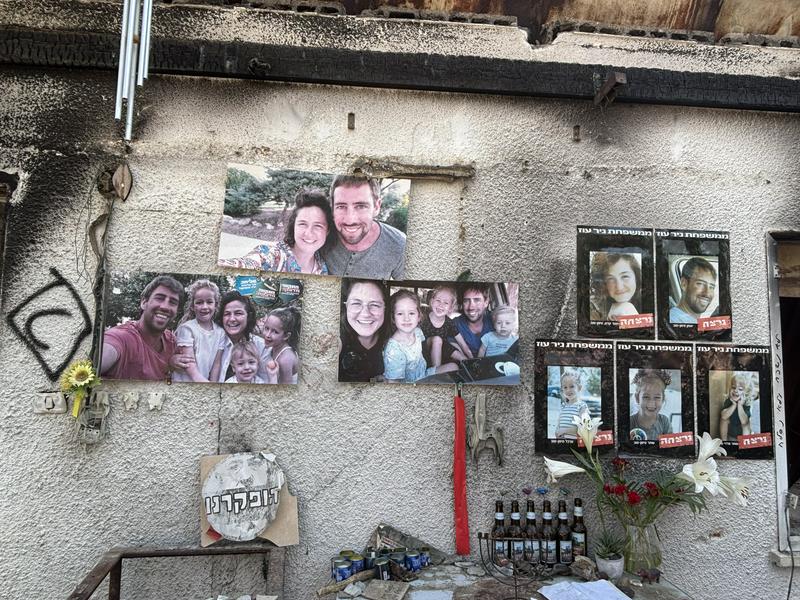
Other families were not spared. Mary's house was burned almost beyond recognition. When soldiers finally reached the home around 1:30 p.m., they found Mary, her husband, and their three young children—none older than ten—dead behind the door of their safe room. The steel door was riddled with bullet holes.
Ola's father-in-law, Yoram Metzger, was also among those killed. He and his wife, Tamar, were taken separately by two different groups—both composed of civilians rather than Hamas fighters, according to Ola. Tamar was released after 53 days as part of a hostage deal. Yoram was murdered in captivity in Hamas tunnels.
The involvement of civilians shocked Ola deeply. For decades, residents of Nir Oz had regular contact with people from Gaza. Some, including her parents-in-law, volunteered to help Gazans travel to Israeli hospitals for medical treatment.
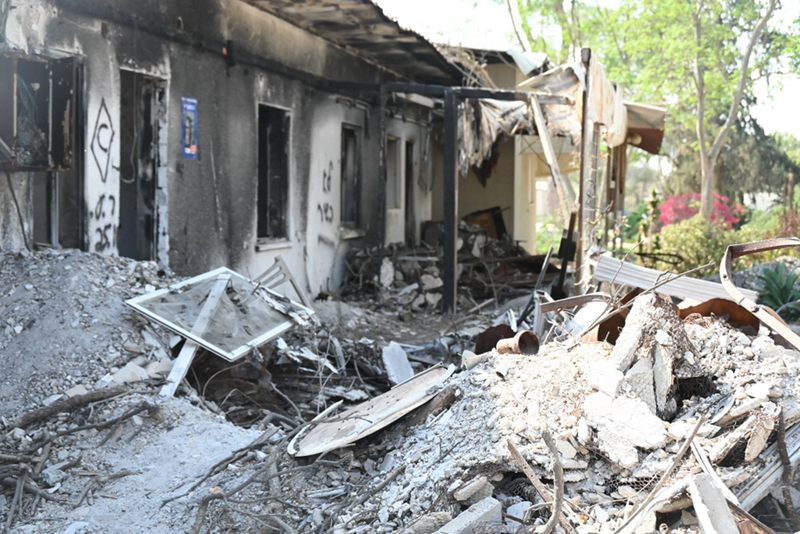
Today, walking through Nir Oz, the devastation remains unmistakable. Yellow and black flags hang throughout the kibbutz—yellow marking those who were kidnapped, black marking those killed. Where both colors appear together, they signify victims who were murdered and whose bodies were taken.
Of the kibbutz's 229 homes, only seven survived the invasion intact. Most others were burned or demolished. More than two years later, Nir Oz still resembles a charred ruin, though slow reconstruction has begun.
"We are rebuilding," Ola said. "But the trauma is still here."
For residents of Nir Oz, October 7 is not only a date but a rupture—one that reshaped a community built on agriculture, cooperation, and long-held hopes for peaceful coexistence. As reconstruction proceeds, memory remains etched into every wall left standing and every flag still flying.